Showing posts with label GRN. Show all posts

Thursday, January 10, 2019

What I Learned from GRN Draft - Boros and Selesnya

Boros - The Value of a Tick


Tempo is a subject people can argue about basically whenever someone wants to start a Twitter fight. The most useful metric I've found for it is making it discrete. The concept of a “tick” is getting a tangible play ahead. If you Take Heart to win a three drop combat then play another creature, that's a tick ahead.


Due to the playable depth of Guilds of Ravnica, you often had to make decisions about what spells you wanted in your Boros deck. Two of the common borderline cases were Command the Storm and Sure Strike. You often hear things like “Sure Strike is basically removal in this format”, but conceptually what causes that is hard. It isn't just a format being fast or slow, that would be too easy.


Back to the tempo discussion, the upside of Sure Strike is that it often puts you up a tick. It costs two and can slot in with another play where Command the Storm just won't.


Boros just made it very clear what the value of that tick was due to Mentor, and also the flatter creature sizing. Getting ahead a tick in Boros was almost always putting you ahead a tangible attacker for turns. That pushed Sure Strike ahead of Command the Storm in most scenarios, with sideboard options for Izzet non-blocking races or Dimir too much removal for tricks scenarios.


This valuation is basic in game “do I use my trick” stuff. In future formats, it should be “do I value this in draft and deck build” from the start. Can you get a tick ahead with the trick, and looking ahead what does that tick of value produce?


Selesnya - Play to the Pieces, Even Cogs


Really early on, everyone figured out Selesnya Convoke didn't work. Then we all figured out Selesnya is green Boros. You make a bunch of cheap creatures and battle with combat tricks, maybe convoking one or two larger things.


I’ll take this minute to scoreboard, as I had this down from the first week as evidenced by my first draft at Grand Prix Montreal. The trick is to not just build around the payoffs, but build around the enablers or cogs you are given. Obviously your first instinct is going to be trying to cast Siege Wurm, but when that fails you have to take a step back to the other pieces.
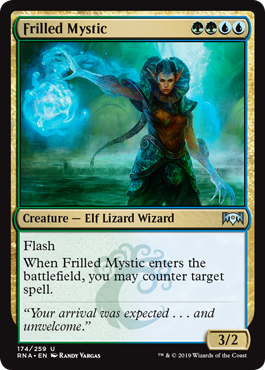


A theoretical example from the upcoming Ravnica Allegiance format. Maybe the payoffs for +1/+1 counters aren’t great, but there are a number of reasonable adapt creatures. These are cards that pay you off for a slightly longer game and not trading as much early, as well as having instants as you can adapt at instant speed. A Simic deck could find itself with a defensive slant with counterspells, utilizing adapt to maximize the number of large late game bodies it plays without clunking out too much. This might even promote an Azorius splash. And look, Frilled Mystic is the Simic hard to cast uncommon and it points to this instant speed countermagic strategy! Think like this, and you will find a lot more lanes open up to you in a draft than you expected.

Three or Five Color - Why It Failed

True multi-colored decks were scarce in Guilds of Ravnica. The only reliable one was Grixis, usually Dimir splashing Hypothesizzle, and besides that it was mostly a loose splash on half of Status // Statue or a mythic rare. Looking back six years ago at Return to Ravnica and Gatecrash, we saw three colors be fine in Return to Ravnica but utterly fail in the aggressive Gatecrash. The Crackling Drake cycle has something to do with this set, but we can look at how it was similar to Gatecrash and see more reasons.

Putting together the past examples, I think the main thread is how important two and three drops are to your deck, especially multi-colored ones. The constraint on being one guild or splashing is just how much you can afford to be missing one of your colors on turn two or three. Selesnya and Boros largely couldn't. Their two drops were much better on time than a turn late, and they were evenly split between the colors. Goblin Electromancer on the other hand was a fine later play if you were immediately getting a one mana rebate on another spell, and Dimir just didn't care about two drops, allowing the Grixis merger to be clean.
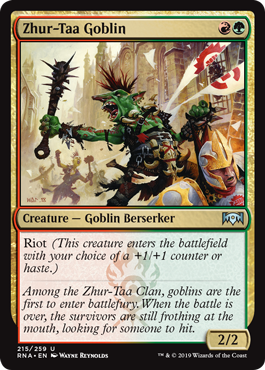

Watch for this especially in Gruul in Ravnica Allegiance. If the guild is about slamming three and four drop riot monsters at your opponent, consider a splash. Orzhov could go down a similar road depending on if afterlife is used as an aggressive tool to keep value on wide attacks or as a defensive tool to grind opponents down. Simic is already pointing towards a slower deck that probably can afford a splash as per previous, and you probably don't need a hint on where Azorius and Radkos fall on the curve out to control scale. Overall I expect Ravnica Allegiance to be a lot more splash friendly than Guilds of Ravnica, but we will see when the full set is previewed soon!

Tuesday, January 8, 2019

What I Learned from GRN Draft - Golgari, Dimir, Izzet


Golgari – How to Play Versus Better Things


What actually was the issue with green in Guilds of Ravnica? Jump-start and surveil and flat power levels. While the guilds all had their own identity, their creatures were all about the same in raw size. Douser of Lights was king, not some green donk. Jump-start and surveil meant the blue decks were just too good at ensuring they kept drawing spells while the green decks didn't have the same mechanisms, so eventually they would flood and die against good control.

Golgari specifically had this issue in spades. You had to exchange cards repeatedly to power up your undergrowth cards, and trading just maximizes your opponent's innate ability to draw better than you.

You won by ensuring you traded profitably every time. Not just getting a little bit out of every exchange, like with Spinal Centipede, but ensuring your pieces of cardboard all traded up in some way. Your end exchange wasn't just a full graveyard, but your opponent left with bad 2/2s to your remaining large creatures.

All this is building to say that Generous Stray, Burglar Rats, Ironshell Beetle, and Severed Strands were all unplayable. Every time you draw a card that doesn't exchange profitably in any way you are setting up for an easy loss and none of these do that. Even if you draw Severed Strands with a Burglar Rats you are still making medium exchanges, and that's the best cast scenario.

Ironshell Beetle was probably the most subtle offender here and took the most times failing to see why it was bad. A 2/2 doesn't trade for much, a 1/1 doesn't trade for anything, and a +1/+1 counter on a 4/4 or similar doesn't change how it trades in this format. It didn't do anything besides exist on curve when every other option did more. 

Maybe it's just a factor of how slowly this format played out, but I should be considering these card quality over a game factors more in other formats. This is always something I've run off intuition on before, and it's good to have a solid example and metrics to go to.

Dimir - Second Level Questions


You have Artful Takedown turn four on the play. Your opponent controls Wojek Bodyguard and a Fresh-Faced Recruit. What's the play?

Can you see the future?

Dimir was an archetype that often asked you what the game would look like on turn nineteen. Evaluating if you really need that land on turn five if you will draw another later, tracking their relevant cards against your remaining answers, lining up counterspells to protect your few threats, and not decking is all stuff I'm used to from weird decks in other formats.

Artful Takedown just posed another set of questions I wasn't quite ready for at the start.

The assumption is that full value from Artful Takedown is both modes, but I quickly found myself casting the card just as a kill spell. On a basic level it makes sense, you are playing Artful Takedown for the kill effect and not the tap effect. In the Wojek Bodyguard situation, I would be asking myself two questions about the future of the game.

The first is do I have a second line of defense against Wojek Bodyguard even if Take Heart shows up? That means an actual way to prevent it from attacking, not just a Wishcoin Crab that lets it jam and spread counters around. The weird part here is that often that answer should be a deathtouch creature that would already be on the battlefield, in which case you would rather just let them attack with Wojek Bodyguard into it now and save Artful Takedown for a creature you can't answer with a block.

The second is do I have a solid upcoming blocker for Fresh-Faced Recruit? If my other plays are all low toughness blockers, I'm more inclined to go big and save the life. They are likely to have another creature to cast this turn, and if they have a tempo-positive removal spell as follow up to that I'm going to need every bit of life to line my future blocks up and not die.

This depth is part of what made Guilds of Ravnica so replayable even if the draft portion was fairly scripted. Even if Rubblebelt Boar, Parhelion Patrol, and Hammer Dropper were all fairly interchangeable four drops, once you got in match the consequences of each one in your deck or across the table were huge. Over a three game Traditional match, learning your opponent's creatures, tricks, and adjusting your cards in deck and play to beat them came up time and time again.

Izzet – Adjusting for your High Picks


Golgari, Dimir, Boros, and Selesnya were all one plan decks. Maybe you could consider “All Rares” Selesnya or “I got three Dimir Spybug” Dimir different, but it wasn't reliable.

Izzet presented a unique scenario. Most people knew you could flex between the Izzet Tempo deck with Leapfrog to Izzet or Grixis Control. But there was even a third option: If you got a couple Wojek Bodyguard, you could go hyper aggro Izzet with Vedalken Mesmerist. Each of these decks was really good and capable of a 3-0 if Izzet was open, so you had flex paths from early Dimir or Boros into Izzet. Those are the two other best guilds, and this was why in the mid-format where it was less contested Izzet was such an amazing deck to draft.

This is a lesson for next set. The core of guild or other fairly linear draft formats is figuring out how to pivot. You can pivot with “Boros” cards into Izzet if those gold cards keep coming around, and figuring out how to do similar things to make functional subarchetypes is going to be big in Ravnica AllegianceI always looked at things the other way, identifying good cards as those that naturally flexed, but actively finding ways to pivot "archetype-specific cards" into a different archetype pays off by finding niche decks like Izzet All-In Aggro. Ravnica Allegiance is probably going to be playable dense enough that you can pure swap fairly late just like this set, but if you can keep playing your early picks like Wojek Bodyguard why drop them? 

Wednesday, January 2, 2019

Guilds of Ravnica Most Improved for Best of One


Bigger Convoke Creatures


The entire point of convoke is to turn creatures into mana. The ideal scenario involves you playing creatures and lands to set up an early fattie, and in Guilds of Ravnica you are mostly stuck with one creature for one card invested and not token generators.

In Traditional draft, you often have hands with a couple more lands than you want and as a result a few less creatures. Those hands make Siege Wurm horribly clunky and that's why the card went from a game breaker in past convoke formats to mediocrity in this format. I'll play a Siege Wurm in my Traditional Selesnya decks if needed, but I would rather cut it.

In Best of One that whole too many lands thing isn't really an issue. The format makes curving out on creatures even more desireable. Siege Wurm is reasonable to cast almost every game, though still not something you want to draw multiples of. In Best of One I generally want a Siege Wurm, if not a second similar card.

Arboretum Elemental is still trash though. Nine is literally millions. I'm not big on Worldsoul Colossus either but it at least can be cast.


High Drops in Aggro


Light of the Legion was a contentious card in Traditional draft. I was always on the side of wanting a giant flier in my white decks, but other Pros made the argument that a card that costs six did nothing to advance your typical Boros or Selesnya game plan.

In Best of One, you draw significantly less two land hands and more three land hands. The odds of having turn six Light of the Legion from a two land hand are literally half the odds of having it on turn six starting with a three land hand. A six drop from a three land hand is actually easier to cast on curve than a five drop in a two land hand, and you would play a Barging Sargent in a Traditional draft.

Does this not violate what I said about six drops clunking up hands last week? Well, back to the five drop comparison. Yea, sure, your flawless Boros deck might be all cards that cost three or less, but usually you need some high drop hitters for quality and there isn't any better than Light of the Legion. Swathcutter Giant isn't bad either.

It's also a different role. You relied on Cold-Water Snapper to stabilize, and that's awkward. You rely on Light of the Legion to break games that have kept going past the point your main aggro cards are at their best.


Versatile Anti-Fliers


One of the spots you can sideboard heavily to shore up a weakness in Guilds of Ravnica draft is cards that beat flying creatures. Healer's Hawk, Skyknight Legionnaire, and Parhelion Patrol are all common threats you face that are scarier with the Best of One improvement to mentor strategies.

While you don't want potentially dead cards in your deck, both Hitchclaw Recluse and Crushing Canopy cover the spread. The Spider blocks random three power creatures, which includes fliers with mentor counters. Crushing Canopy kills Luminous Bonds and Maniacal Rage, though I'm still not sure if the enhancement auras actually get better in Best of One or are just overpopulated from less experienced drafters on Arena. The only matchup I don't want these cards against is Golgari, and at that point they are just a card that is worse in one matchup like many others.

Honestly, I probably should have started Crushing Canopy in more Traditional Guilds of Ravnica drafts. I was just adverse to non-creatures in green decks due to convoke and undergrowth, and only tended to draft those decks when they were open enough to get other removal.


Lifegain Bodies


There are a lot of lifegain creatures in the Selesnya colors. I would sideboard them all in against aggressive decks like Boros or Izzet, but even with a faster format why would I want to pre-sideboard here?

These are all solid bodies on their own. Three mana 3/3, convoke 3/4, and five mana 4/4 aren't insane head turners, but they all fight at rate against other creatures. I have sideboarded these in against Dimir decks in Traditional draft just to have more threats and less pump spells. If I'm fine having them across the board and they win me the most important matchup of Boros, that's a starter card to me.


Deathtouch Creatures


In Traditional Guild of Ravnica draft, I felt both of these deathtouch common creatures were fine but cuttable filler. They did their job and traded for things, but at the end of the day Spinal Centipede also trades for a card. I would rather have the slightly higher power creatures to pressure opponents who miss lands or spend time not building a battlefield and not have smaller creatures against Grixis control decks.

In Best of One draft, you have to face larger creatures faster. Douser of Lights is distinctly slower than Rosemane Centaur , but Pitiless Gorgon trades on the spot. If a Vernadi Shieldmate picks up a +1/+1 counter from Blade Instructor, Hired Poisoner picks off the 3/3 where a random 2/2 for two mana wouldn't. Your opponent can't Take Heart over your blocker, only the more expensive Sure Strike works. The sure trade is just really important, and you aren't running anyone over with mediocre beats to their good beats.


Tuesday, January 1, 2019

Breaking Arena: Best of One Drafting


I have drafted a lot of Guilds of Ravnica. Probably not the most in the world, but easily triple digit drafts between Magic Arena, Magic Online, and real life. My drafts are also cleanly split in time. I spent the entire Pro Tour lead up testing via classic methods, then started playing Arena after.

And the two are distinctly different formats. They use the same cards, but you need to adjust to be successful. For Traditional draft on Arena that adjustment is small, but Best of One draft is as different a format from Traditional Draft as that format is from Sealed.

Hand Fixing


In Best of One matches, Magic Arena doesn't just draw your opening seven. It draws two hands, then selects the one with approximately the most average number of lands. Or something like that. It isn't quite as clean as just the average-est hand to avoid weird exploits, but it's probably close enough.


So much of good Limited practice, or really just Magic in general, we have learned over the last 25 years is rooted in the idea of mitigating early spell and land imbalance. Many top Limited players cite cycling as their favorite mechanic as it just solves all of this. Cycle your Desert of the Mindful if you drew five lands early, cycle your Rampaging Hippo if you only drew two lands (Future Topic #1: Why Hour of Devastation was really great).

Best of One has much less of this. With more optimal mixes of lands and spells, games are more based on tempo because things remain closer to that. I'm going to throw out the phrase “random walk” for people who know statistics, but here's the easy mode explanation. The most likely state of your mana balance after a few turns is approximately the same as your opening hand.

One of the deeper lessons of Traditional Draft is that you can't consistently rely on your early draw steps to un-mana flood or screw you. The odds change a bit, but they aren't drastic. The inverse is that if you start fairly balanced on lands and spells, you are really likely to have lands and action through the first several turns of the game.

Magic when both players “always” hit their fourth land and have enough spells to reliably curve out looks really different.

If someone falls behind, it's much harder for them to get back from behind. Your opponent is not going to miss a land or spell, so their plays are just going to be at parity with yours. You need ways to effectively tick ahead on a turn, like cheap tricks or removal, or plays that are impossible to match at parity, usually rares.


If you miss a turn of plays, that's falling behind. The easiest way for that to happen is drawing spells you can't cast on time or cards that make you spend mana without advancing your battlefield. Dominaria Best of One took a huge hit here. Divination and Cold-Water Snapper were amazing in Traditional draft, but both were just OK in Best of One. Six drops clog up your hand in the early turns, and Divination on turn three is a liability now. Lots of the Izzet jump-start cards in Guilds of Ravnica draft lose ground here. Maximize Altitude doesn't provide a sticky proactive advantage up the curve, is just a conditional late game breaker that could dismantle out of place draws.


This also hurts splashes or three color decks. Mana fixing costs time, as does the “mana fixing” of waiting to draw your third color. That time cost can really kill you in Best of One.


Draw smoothing also takes a hit if it comes at a cost. If you have lands and spells, why bother spending mana to ensure you have lands and spells? Divination loses ground here again because its main purpose was reliably hitting your fifth land drop. In Guilds of Ravnica draft, that punishes jump-start a ton. Radical Idea is the pinnacle of mana for filtering. Surveil is mostly incidental on already good cards, so it just drops from amazing to solid.

If both players keep making similar drops and drawing cards for mana is a real cost, card parity is hard to break. Mulligans hurt more, both on physical cardboard and because you are less likely to hit drops on curve. If my hand might miss on color but has plays I'm more likely to take a risky keep. Keeping draws that won't hit curves is worse than normal though so ship those brick draws right away. Card advantage without spending a turn not impacting the battlefield is always insane, it's just now more insane.


What gets better? Any mechanic that provides increasing advantage for battlefield presence. Mentor and convoke are huge winners in Guilds of Ravnica, not that mentor was bad. Convoke is just great when you have lands and creatures up the curve, but stalls cards in your hand if you miss a drop which just doesn't happen as often.

Sideboarding


Despite being the main thing that jumps to mind when you think of Best of One, sideboarding is one of the smaller Arena impacts on Draft. Two reasons: hand fixing skews things way too much already, and sideboarding is often specific to their exact cards.


The first one is simple. If drawing blanks is really punished, can you afford to draw a Mephitic Vapors when they curve Vernadi Shieldmate into Rosemane Centaur and not Fresh-Faced Recruit into Blade Instructor? Main decking a true sideboard card in Best of One might honestly be worse than doing it in best of three. At least then you can reasonably put a Radical Idea in your deck to fix drawing your bad card.

The second is just good Magic. Not every Boros deck is going to fold to Mephitic Vapors. They might be less Ornery Goblin, more Vernadi Shieldmate. These are things you have to evaluate based on the actual cards you see in a game, and Best of One will never let you do that. Pre-sideboarding against an archetype these days isn't 100% effective like Gloom was. 60% of the time it's reasonable, not every time.


Where I like to make up pre-sideboarding ground in Best of One is with cards that are more general purpose effective with upside against cards or archetypes. The best example of this is Hitchclaw Recluse. I rarely played Hitchclaw Recluse in Traditional Guilds of Ravnica draft because it was reactive in Selesnya and didn't trade in Golgari. In a more proactive Best of One format any three drop plays fine, and green needs ways to hedge against fliers that it can't race.

Bots


(Future Topic #2: Drafting with Bots)

No, this isn't just a place holder, it just is a whole entire new set of implications that apply to Best of One and Traditional draft. This is also going to be very presumptive. I know how bots can be programmed, I can make guesses as to how Wizards of the Coast has them programmed, but I don't have their code base so I can't say for sure.

Best of One specific guesses? The name of the game with bots is exploits, and I would assume Best of One and Traditional use the same bot evaluations. That's going to create some gaps where cards that are vastly improved in one format sneak through for the other. Do your best to figure out what cards the bots undervalue for the format you are drafting and adjust accordingly.

You can certainly learn skills that transfer from Arena to real life for a format, or the reverse, but if you want to rank up to Mythic and win a physical event you have to train for two parallel events. As I said the cards are shared, but the rankings and assembly may vary.