Showing posts with label Theory. Show all posts

Thursday, June 6, 2019

The Unknown Shores Rant: The Cost of Fixing in Limited

Last post there was a rule of War of the Spark Limited I skipped. Because it’s this entire post instead.

Rule #6: Splash Less Than You Think, Then Even Less Than That


Why? The fixing just costs too much.

Let's define what too much means.


Shimmering Grotto and Unknown Shores have been around a long time. For a lot of that time, I’ve gone to a classic (Andrew Cuneo?) quote for these cards.

“You know they allow you to play as many basic lands as you want?”

When you play Shimmering Grotto and use it for colored mana, your spell costs one more.

In your average Limited deck, how many cards would you be happy paying an extra mana for?

Have you played Limited decks where your cards are all slightly overcosted D-level playables? It is horrible, and you lose a lot.

That’s what happens to your on color cards when you play Unknown Shores. Sure, if it was an off color basic land you couldn’t cast your spells, but playing a turn behind the whole time is still really bad.

This also applies to the spell you are splashing. The issue is a bit more debatable here, but keep in mind it is still an issue. I would pay gladly 3B for Ob Nixilis’s Cruelty, but I’m unsure I would be excited to play that card if it meant risking my mana for the rest of my deck.


The real failure point is when someone splashes a multicolored uncommon creature this way. Pirates and Dinosaurs in Ixalan were huge offenders. If you splash Storm Fleet Sprinter and pay four mana for your 2/2 haste unblockable, is that really better than an on color four drop?


The one thing Unknown Shores is okay at is making all five colors at once. Mountain doesn't cast Doom Blade and Lightning Strike in your Azorius deck, but Unknown Shores does.

My usual answer to this kind of deck building is just play better mana and worse cards. Unless the cards are super broken rares that autowin games when cast on turn five or turn fifteen you aren't gaining enough, and even then Unknown Shores better be the last piece of five color fixing you need on top of a few others. You can wait for a format with better five color fixing to have fun.

This is probably a good time to bring up the caveat that splashing without any fixing is typically a bad idea. I don't have the true numbers, but the basic gist is you usually need at least eight sources of your primary colors to reliably cast those spells early. You need three sources of your splash color to find it semi-reliably, two if you are OK waiting until you have seen a larger portion of your deck. The bare minimum for a two color deck and a splash is eighteen lands, and that's straining your mana to do it. This worked in Dominaria where the format was slow, full of card draw, mana intensive so eighteen lands was good already, and having another impactful card mattered a lot, but not every format is as forgiving.

War of the Spark Fixing Costs


The big issue with splashing in War of the Spark is taking a turn off. The concept of playing to the battlefield is just hammered home again and again by planeswalkers on both sides. If you take a turn off for fixing that's a wrap.


Hmm, that sure looks like spending a card and a turn.


That's also a turn. So is Gateway Plaza.


That's a turn spent producing a creature and fixing. And Paradise Druid blows all of these out of the water as a fine two drop that lets you dump your hand faster and splash.

I think the point should be clear. The non-green fixing costs a turn, the green fixing largely doesn't.

I'll also bring up that if you aren't green, you are blue or in Mardu colors. Mardu trios are too proactive to want to typically splash, or Orzhov which has its own issues. Dimir and Izzet already struggle with playing to the battlefield to defend and pressure planeswalkers, splashing only opens that weakness up more.


Azorius though I don't mind a splash in. The spots where I've found splashing in non-green decks to work are largely on the back of the cheap, easy to pick up white removal duo of Gideon's Triumph and Divine Arrow, using those to recover the lost tempo.


I'm still splashing unbeatable rares if possible, but my bar for possible is higher. I'm also way more partial to non-planeswalker rares that don't get much worse if I spent a turn fixing. The odds I splash Enter the God Eternals off colorless fixers are higher than the odds I splash Sorin, Vengeful Bloodlord.


Again, this is all outside of green. In green, I'm fine mixing fixers that play to the battlefield with those that don't to get workable splash mana.

Why is New Horizons exempt from this? First off, the +1/+1 counter is often relevant battlefield presence. The proliferate upside is really overstated, but it's there. And the double fix lets you splash even more absurd cards like God Eternals, making New Horizons unique for the format.


To look back a set to Ravnica Allegiance, splashing was great even at fairly high costs (Open the Gate for Gateway Plaza is how much mana?). The reason is simple to derive. There were absurdly high power uncommons to splash that could easily make up for spending that time, like Archway Angel and Gates Ablaze. Even in a not all-in Gates deck, the multicolor cards were just distinctly. If your opponent played random mono-color creatures with untapped lands, then you played Aeromunculus and Frenzied Arynx with mostly tapped lands you were way ahead.

And unlike Guilds of Ravnica, these splashable cards were just face value good without synergy. In that other format, you could splash good removal like Artful Takedown or Hypothesizzle, but the power in multicolor cards was largely low cost creatures like Skyknight Legionnaire or linear payoffs like Goblin Electromancer. You could splash but the odds you found a card worth it were just low enough that it was unexpected, where in Ravnica Allegiance the main reason to not splash was that other people took all the fixing you needed to reliably do that.


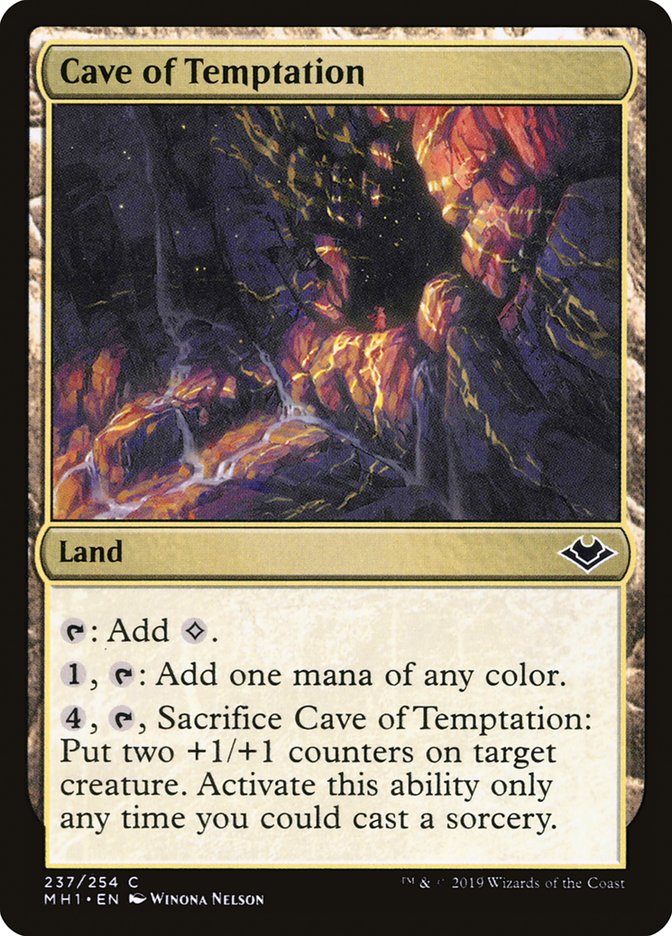
This all brings us to the Unknown Shores variant in Modern Horizons: Cavern of Temptation.

Modern Horizons isn't going to be as tempo-oriented as War of the Spark, just because there is one planeswalker per sixty packs instead of one per pack. I would be into playing Gateway Plaza in this format.

But this is an Unknown Shores, not a Gateway Plaza. It's a per use tax, not a one shot payment.

I'm not going to tell you not to play Cavern of Temptation. Just play it as a land that sacrifices for value more than a fixer.

Monday, April 29, 2019

The Issues with the London Mulligan

The premise is always the same. The worst part of Magic is that sometimes you don't get to play Magic in a game of Magic. People always propose ways to fix that. Every time, the problem with their solutions is the same.

The best part of Magic is that games are constantly unique. You have to adapt to different situations, and two matches between identical decks can look massively different. Every time you try to reduce the variance responsible for "non-games", you eat into the variance that makes Magic great.

The Vancouver mulligan was definitely on the right side of this balancing act despite initial concerns. It was comically obvious the first time you played with it the rule was a strict upgrade. You immediately learned mulliganing for the nuts was unreliable, and that keeping riskier six card hands was less of a crap shoot. All upside.

The London mulligan is not on the right side of this balance. My first reaction was anything but it being an obvious upgrade.

If you want the short version: the London mulligan homogenizes game play, promotes mulligans in ways that further push this, and trades "non-games" where someone doesn't take actions with "one note games" where someone takes exactly two or three actions and the other person either answers them and instantly wins or misses and instantly loses.

The Fair Side


It isn't entirely fair to the London mulligan to judge it by the broken half of things from Modern. It was largely designed to make mulligans less painful in Standard and Limited.

The problem is it doesn't.


In Limited, too much of the game is determined by raw quantity. "Every draft deck is a form of midrange" is the classic saying, and part of that is playing five and six cost cards that require you to invest five or six cards into lands. Every time you mulligan, the cardboard cost to play lands is much larger relative to your hand size. You can't hit all your lands and plays due to the lost card. Mulligans in Limited still suck with the London mulligan rule.

Same with Standard most times. Luis mulliganed two non-functional hands against Andrew at Pro Tour Guilds of Ravnica. Even if he stacked his five or four card hand he would be massively behind to a reasonable seven. I doubt any simple solution that still leaves someone down cards combats this sufficiently.

That means there are three min-max viable plans after a London mulligan. Ship your end game and hope an early curve dunks on your opponent, keep some rare that solos the game and just enough to tread water to get there, or keep no early action and hope you don't die before casting a couple heavy hitters.

This is not the most dynamic game play. I would categorize the first two categories of uninteracted aggression or rare as close to non-games, and the last option of hoping their hand is slow having a high percentage of non-games as well. The word polarized comes to mind, where old mulligan games were more mixed plans and shifting struggles against the lost resource.

So instead of non-games from turn zero, you have games where people play cards for a bit but continuing decisions don't exist or don't matter. This is just as bad, aka the Solforge problem or the Turbofog issue. It's better for people to be done with a non-game faster than to spend more time for a marginal percentage of their opponent's draw horribly failing, or to just push the variance off to later draw steps where you need to hit perfect to keep up pace. This is doubly true in online platforms where you can just queue up again if you lose fast.

Aside: this may be less true on Arena because of the ladder system emphasizing every match win. In Magic Online leagues where you just lose and instantly rebuy one bad match it is easy to write off in a session. But the Arena loss sticks to your rank. This is a whole separate discussion on why ladder systems are unhealthy, where emphasizing tilt over simple bad luck is only one piece of the puzzle.


I'm overselling this a bit. As always, the first mulligan is certainly something you can overcome in a dynamic longer game. Divination isn't three mana win the game. But five cards? I still struggle to imagine dynamic Limited games where one player started down two cards and forced themselves down a non-scrappy plan with mulligan selection.


There's also a boost to conditional cards from this mulligan rule that I really like. One of the issues of conditional cards in Draft, even pump spells, is that they are liabilities if you mulligan and struggle to find a spot to covert them to true value. Now they just go to the bottom of your library, and Limited is deeper the more reasonable but unique effects people get the choice of playing.

Aside: forcing people play a bunch of mediocre conditional cards is how you get Avacyn Restored, giving them the option is how you get all time greats like Innistrad or Iconic Masters.


In Standard it is much the same. If Mono-Red Aggro mulligans, it is looking to keep one drop, two drop, three drop, burn spell, two lands next hand. The late game is hope to draw well or hope they don't get there.

I keep using the word dynamic, and I think dynamic games are the loss here. The puzzle of how you want the game to play out is much more solved from turn zero, especially as you are incentivized to try again on hands that don't execute it well. This then echoes back to opposing hands, where they are incentivized to combat your scripted plan, and back and forth.

The London mulligan does make something like Sultai midrange mirrors way more dynamic as your sixes are more likely to recover your card with explore creatures and play up the curve, but I don't think Magic really needs to promote that specific effect more. Value bodies up the curve is already the defining strategy of Standard over the last several years.

Again, the first mulligan doesn't assure that any of this precise scripting happens, but the second one sure does reduce games to it.

I'm also thinking mostly from a player and analytics perspective. I'm sure a game where someone plays some cards, gets hard bricked, then loses broadcasts better than someone doing nothing, even if in both cases the outcome was almost certain from the start.

The Unfair Side


This is the real bad stuff.

Starting from Standard, the biggest issue is probably the high impact hate card one. The London mulligan makes it extremely probable you find a specific card. If that is a card that breaks a matchup, you can approximate sideboard games as that card showing up and both players warping everything around it.


This isn't a consistent pattern across Standard, but it exists in some spots in almost every Standard format. Cry of the Carnarium versus Azorius Aggro. Rampaging Ferocidon or some other hate against God-Pharaoh's Gift. Some swingy life gain spell against Mono-Red Aggro. Kalitas, Traitor of Ghet against Rally the Ancestors.

The reliability of these hate cards when they exist makes the idea of a secondary plan less a small shift and more of a requirement. You have to aggressively mulligan to anti-hate, or just give up on playing the basic strategy you registered two games in a match. It's one thing to have to fundamentally repurpose on your chosen strategy because they have full deck coverage, it feels shitty when it's because one card exists. And its not like you can make a format without those hate cards, because an extra consistent linear deck with no answer is bad news. Or not make a format without potential for these decks, otherwise we would have that and not Aetherworks Marvel or Nexus of Fate.

These one card wins aren't restricted to sideboard games. The extreme of this would have been Mono-Black Devotion under this rule, with Pack Rat or Underworld Connections. More recently some decks could never beat Cryptbreaker, Hazoret the Fervent, The Scarab God, Tireless Tracker. Five cards or seven, these just override any disadvantage. Again, if Magic could exist without these occurring reasonably often it would by now. Or at least the post-Mana Leak, post-Baneslayer Angel, post-Inferno Titan design era.


I think it's fairly straight forward to say more Pack Rat games is not good for the game.

After this, we leave Standard for older formats.


One thing we quickly found in testing London mulligans in Modern was decks that couldn't have a reliably good draw off five cards didn't gain a lot. It could be due to card quantity, like Amulet Titan, or a lack of redundant pieces, like Goryo's Vengeance. The first mulligan gave you one more shot, but the upgrade from the Vancouver mulligan to the London one wasn't huge. It was abusing the second or even third mulligan where stuff drastically diverged.


The decks that meshed low required card count and redundancy were the winners. Tron, Dredge, Cheerios, and Simian Spirit Guide - Chalice of the Void. None of these are really fun strategies. They also aren't unbeatable, largely because of the degenerate sideboard interplay I mentioned prior. You can sweepingly ban these decks, but are they too good on power? Can you assure that next set something else won't break this way? Are you just turning Modern into another midrange format, both with a power level chop and a push towards midrange decks finding their Fatal Push hands or Stubborn Denial hands more correctly?

The margin between linear but too consistent to be reasonable playable and linear but too inconsistent to be playable dries up real fast with the London mulligan. More unique game play is lost.

Aside: back to Standard, the decks that can win off one, two, three curves are built for this redundancy and I would expect to be able to regularly have five card hands that fire off quick beats.

Even within the context of these decks, unique game play is lost. Playing against medium Dredge and Tron hands used to be fairly interesting with the other player really judging how they can best use the extra time, and now those medium games don't exist. In testing we would mulligan every Dredge seven or six without multiple discard enablers. Few Dredge games were the slower build up games where the opponent had to figure out how quick they needed to play before things snowballed while still avoiding key points like Conflagrate. It was just a bunch of turn two eight power nut draws.


This then pushed hate cards towards the more absolute and fast, like Leyline of the Void. Sideboarded games became very scripted. Death's Shadow had two types of openers: Leyline or no. Dredge could almost always mulligan to an answer and enabler. The non-Leyline hands didn't beat Dredge sevens, but they might beat lower hand sizes. The Leyline hands won on the play via Thoughtseize on Nature's Claim, often lost on the draw to turn one Nature's Claim, or had double Leyline and it was all over. No decisions about what to Surgical Extraction, fewer about Dredge staggering damage production to minimize Death's Shadow sizing. Just binary outcomes the whole way.

Additional mulligans into functional games is also a strain on tournament logistics. Normally a mulligan to four means a quick game. If you now both mulligan more and play typical games more and (partly because of open deck lists) play into interaction more, rounds just take longer. You are losing minutes a match in shuffling overhead in Modern, and despite a much more aggressive format I would bet the average Modern match at MC London took longer than at PT Bilbao.

Now that I mentioned open decklists, that shift doubly amplifies all the issues with the London mulligan. More pre-scripted game play derived before the games start, lowered risk for aiming for the best possible hand for the situation, more mulligans and time spent shuffling even by decks that aren't linear.

A Fix


The problem is the same in every case I described. Five card hands with the London mulligan play Magic, but it doesn't promote good Magic. But the London mulligan fundamentally promotes maximizing decks for mulligans to five.

How can we shift this?

My best suggestion is increase the cost of that second mulligan. The mulligan rule I would like to look at is similar to the London mulligan, but always bottoming one card and losing access to cards after the first mulligan. So start on seven, then mulligan to seven and bottom one, then six bottom one, five bottom one, and so on. This is two steps from the Vancouver mulligan, giving you both the extra card of info prior to a mulligan decision and the ability to send back any of your cards. It preserves the London mulligan in full for the first redraw, giving normal decks a better shot at keeping a closer hand, but starts to punish more aggressive mulligans. It also simplifies the selection process, similar to why Scry X Mulligan was rejected in favor of the Vancouver mulligan.


The space I haven't explore is drastic decision alternatives. Pokemon used to give the opponent an extra card (I know this is bad), there's the classic one shot cycle some cards (one shot also not great), and probably even more options along these lines. Go down a card, but then Abundance the first draw choosing land or non-land (some broken one land applications).

I get that there are a number of pressures with the changing landscape of Magic that promote a shift in how mulligans work. Arena and coverage have new demands, but from a depth of play and physical logistics perspective the London mulligan has too high a cost for too little benefit.


Wednesday, March 13, 2019

Sultai Midrange Is A Beatdown Deck

“How's your Jund matchup?”


It's June 2010. Bloodbraid Elf is still legal in Standard despite literally nothing stopping Jund Cascade since October. Rise of the Eldrazi brought some new hope to the format. My friends were convinced through extensive testing that Simic Polymorph-Emrakul, Naya Vengevine, and Mono-Red Aggro all beat Jund. Bant Mythic, a Noble Hierarch and mythic rare threats deck, was another supposed bad matchup.

Three ten game sets later, I went 7-3 or better against all three rogue decks. I went 3-0, 6-0 against Bant Mythic at the Grand Prix.

This wasn't luck, I was playing the matchups in a different way than most Jund people and my opponents couldn't win.


So here we are in 2019. People are saying stupid stuff like “Sultai is 45% against everything”. And here I am winning 75% of my matches with Sultai.

Oh boy are they all doing it wrong.

Let's break down the old example, examine the past, and see the present in that light.


Simic Polymorph aimed to beat Jund with positioning. Cheap counterspell, single creature, and then there's an unbeatable Emrakul, the Aeons Torn.


Mono-Red Aggro beat Jund via speed and inevitability. Get Jund low on life, keep throwing four damage spells at them.


Naya Vengevine won via recursion. Removal on Vengevine was largely ineffective, and eventually it would grind out the ultimate attrition deck.


Bant Mythic won via a large number of must answer, often hard to kill threats. Planeswalkers, Knight of the Reliquary that immediately held up protection via Sejiri Steppe, and trying to do all of this fast.


Meet Putrid Leech, breaker of spirits, an old school wrecker of plans.

If Simic Polymorph just kept taking four damage, they didn't have time to wait for protection. Or maybe they went off and still died because Emrakul had to wait a turn to attack.

If Mono-Red Aggro just had less draw steps, less turns to unearth a Hell's Thunder, they died.

If Naya Vengevine started needing to chump block, Jund's removal on Vengevine mattered as it ensured other things died.

Bant Mythic’s planeswalkers could die in combat. They could die if you got a bit ahead and snipped their mana by Bolting the Bird.

It wasn’t even just Putrid Leech. Bloodbraid Elf, Lightning Bolt, and Blightning were all great ways to apply quick pressure to your opponent’s life total. They all were good cards at blocking and trading off for threats, but they also killed opponents.


Just because all your cards provide card advantage doesn't mean you have to win by running them out of cards.

“If they are trying to do almost any strategy, of of the best counters is to just go fucking kill him” - Day9 (Sean Plott)


Sultai Midrange today has the same role to play. Merfolk Branchwalker and Jadelight Ranger are really messed up. Every other deck has to pay mana to fix their early draws with a spell. Sultai Midrange gets to do that and put significant power on the battlefield. Other decks have proactive two drops and three drops, but Merfolk Branchwalker and Jadelight Ranger match them on sizing while still putting you up cards or selection.

If your opponent starts bending their deck to be controlling, then your attrition tools come online. If your two-for-one attackers start drawing answers, your opponents will run out of cards due to things like Hydroid Krasis.

Your Izzet Phoenix opponent is trying to pull off some Arclight Phoenix recursion, Crackling Drake, maybe Niv Mizzet or Ral Zarek plans. Just kill them with a 4/3 Jadelight Ranger.

Your Mono-Blue Tempo opponents are trying to assemble these weird protected contraptions of fliers and what not. Just hit them with Wildgrowth Walker and they die.

For some reason the term aggro-control and the idea of changing your role got prescribed to blue decks with Delver of Secrets, but every green midrange deck has all the tools the enact the same role-selection game plan.

If your opponent lets you trade all of your cards for theirs, you don’t have to be the aggro deck. You can bury them in card advantage. But that line has largely been cannibalized out of the format because Sultai Midrange is so good at it, with a few hold outs from Azorius Aggro, Gruul Aggro, Mono-Red Aggro, really anything that says it’s aggro or other creature-based midrange decks.

Sultai's strength is being able to attack opponents who don’t trade for your cards because they are trying to do some wonky stuff to avoid it, then to punish them with raw card advantage if they try to become the control to your aggro. Your removal is utility aimed at the most pressing threats they have that let them outclass your baseline two-for-one bodies.

The pattern is the same as it was in the days of Putrid Leech. If you play Sultai Midrange as an attrition-control deck, that’s when it’s a 45% deck. When you play it as a proactive deck with punishing anti-interaction attrition tools and a good answer set, that’s how you win 75% of your matches.

Fundamental Caveats, aka making fun of Boros Angels: 

-The midrange-beatdown plan specifically works as a window exploit where you have long game to back your optional early game. If your "midrange" deck is just casting non-value fours and fives, your opponent can effectively become the control deck and your deck is only good if your entire threat package is an exploit to the answers of the format, aka if no one has Vraska's Contempt for your Rekindling Phoenix and Adanto Vanguard.

-The midrange-beatdown plan really requires your early drops to be able to play offense and defense. Otherwise your Adanto Vanguard deck might have to play against a different Adanto Vanguard deck that hits you harder while you draw two mana do nothing creatures.

-The midrange-beatdown plan needs to be a relevant clock for the format. Jadelight Ranger is right now. Knight of Grace without your own black permanents to pump it really isn't.

Friday, March 1, 2019

The RNA Draft Meeting Part #2: Pick Order and The Purpose of Them

Part 1 of this breakdown discussing all the Ravnica Allegiance draft archetypes is linked here.

Reminder that this info is mainly for use in drafts against humans, and needs adjustment for Magic Arena bots.

The second part of a good Mythic Championship pick order is establishing a Pick 1, Pack 1 ranking of the better cards. This is then used to rank the rares, which is important because even over fifty or sixty drafts you are likely to have not played with or misevaluated one or two of those due to small sample size.

Let's skip ahead and here is mine, with credit due on some rare opinions to a lot of other great people like Eric Froelich and Andrew Elenbogen.

For comparison, here is Limited specialist Ryan Saxe's pick order.

I personally think a well done pick order is one of the best tools for a draft format, but historically people have rallied against following a strict pick order.

Why Pick Orders Are Bad


It's hard to launch my counter-counter argument for pick orders without covering the classic argument against them. Especially because that argument is right.

Pick orders have been called bad for a long time because Limited is about building a cohesive deck. You need specific combinations of cards to create specific profitable scenarios to win the game. You need to be dynamic in a draft, understand the typical issues you need to resolve, look at your cards
and identify possible new issues to resolve, and pick according to that.

A strict pick order is vulnerable to a lot of contextual pitfalls, but flying loose goose is vulnerable to not just making the theory-optimal play.

To repurpose a Patrick Chapin classic: If you aren't half pick order, you aren't using your head enough. If you aren't half context, you aren't using your heart enough.


Why Pick Orders Are Great


How can you make dynamic decisions about your deck before you know what deck that is?

Pick orders are absolute musts for the developmental stage of the draft, where you are evaluating multiple non-overlapping choices. Sometimes you have to decide between Frenzied Arynx and Imperious Oligarch and knowing which is better is likely the most important context.

The goal of a pick order should be allowing you to evaluate difficult decisions that will determine the direction your draft take before you really lock in on a framework to build within.

The Importance of Grades 


So you have some context. Maybe you have a Blade Juggler, then see Frenzied Arynx or Imperious Oligarch. How do you make that decision?

That's where grading has to come in. Let's say you think Frenzied Arynx is better than Imperious Oligarch here. How much better you think it is matters a ton, as does how you compare it to the Blade Juggler you already have.

When you assign cards a grade like B+ or C, you are trying to cluster things beyond a raw pick order so you can weight semi-informed decisions.

In this case, you are looking at a B level Arynx and B- Oligarch while your already picked Blade Juggler is a B+. That puts Juggler at not quite the level that it's worth a huge concession to stick to, and Arynx is solidly better than Oligarch to the point I would take the Gruul card.

This is where I think Ryan Saxe's pick order is lacking, though it might be due to the cleaner presentation format making it harder.

How People Grade Wrong


Grades as an abstract rating of how good a card is are stupid.

The purpose of grades is to help you quantify the relative difference between early picks.

Too often people use grading scales that are better at delineating between late picks, where context often overrides raw power. There's a couple key breakpoints defining whether a playable is slightly above or below average, but once you get into the D-level cards I don't really care that much. If you are ranking D+ vs D-, you are really just ranking the odds of wanting a conditional effect in the sideboard.

Or maybe they spend a bunch of time grading rares and mythics A+ vs A- and only put the best uncommon in the set at B+. What’s even the point of all those grades ahead of it? You aren’t going to be picking one rare over the others, and at most you are looking at whether a card is so broken you warp your deck for it or not.

Or maybe they just grade 20 cards at B and you have no clue how to rank those relative to each other, so if you see Orzhov Enforcer versus Sauroform Hybrid you don't really know how much better the Enforcer is. Or the reverse case from a pick order, where the fact that fifteen cards are between those two overstates the difference between them in quality.

This issue I solve with the subgrade clusters. Orzhov Enforcer is a B, Sauroform Hybrid is a B, meaning they are both fine early picks but not worth a huge commitment to, but Enforcer is multiple clusters ahead and distinctly better. But if you see Orzhov Enforcer and Enraged Ceratok, technically I like Enforcer more but if you take Ceratok it's about the same. Or if you already have a Trollbred Guardian and see Orzhov Enforcer and Savage Smash, it's a fairly small cost to stick with your first pick.

In the end, you want to end up with something that is an overlap of a pick order and grading. You have all the cards ranked, but with clear breakdowns of where power level gaps occur. Grades slapped on cards have a distinct meaning about the kind of power they offer.

The Pick Order


Again, here's the link.

Some notes on everything:

As I said, grades are being used to somewhat indicate what that section of the pick order is.

A : Rares I first pick over all non-rares. The top batch is kinda A+, where I drastically skew my picks for them, and the second batch is more A where I only moderately skew for them.
A- : Uncommons and rares I P1P1 that I actively bias my next picks to play
B+ : All good cards to first pick, where power uncommons/rares start colliding with the best commons due to various caveats about the cards (CCDD costs, etc)
B: Cards I first pick but am not attached to when I do
B-: The bottom barrel of first picks, in this case the last things I take over a Gate


I’m much higher on good red aggressive cards than a lot of people, and I’m not budging on that. People had mixed opinions on Rix Maadi Reveler and the card has been nothing but busted for me. They had Skewer the Critics much lower, and I wonder if they have ever cast Skewer the Critics and a three drop on turn four. I have Vindictive Vampire and Fireblade Artist really high up as I like the semi-burn Rakdos decks. Feel free to downgrade these cards a bit if that’s not your jam.


Similarly, I’m willing to take Savage Smash over generic removal because it is so much less replaceable if I end up in a Savage Smash deck than Lawmage’s Binding is in a deck with Slimebind access.


I’m very willing to take a heavily committed multi-color card early, hence why Rakdos Firewheeler is just on the border of my top 10 uncommons.


Trollbred Guardian is my favorite card to cast in the set. It honestly makes games too easy. How did they let me play Molder Slug as a common?


Some more specific takes from my Twitter, closely related to this and the notes.

If you have any questions or want to ask about adjustments for Magic Arena, feel free to reach out to me @armlx on Twitter.


Wednesday, February 6, 2019

Limited Design: Making Good Rares


Why Make Good Rares? 


Why the hell does Ethereal Absolution exist?

Some good rares have to exist for Constructed purposes, but Ethereal Absolution isn't really one of those. At best it's a sideboard answer and could have been made a little less egregious and a little more efficient to serve the same purpose.

There's some simple answers that aren't quite the full picture. Some cards have to be the best, but you could make them Jacks not Aces. Good rares acting as a skill equalizer allowing less experienced players to win in Limited is relevant, but again not satisfying. Why not just remove all the rares from the World Championship draft then?


The biggest reason for good rares is providing direction.

Imagine a draft of all players "drafting the hard way", waiting for the signal to move in on an open archetype. They are all taking the best cards, maybe slightly biasing in directions.

Until someone makes a choice about what guild they are in, there are no real signals to read. It's just a bunch of people looking at random pack distribution and backing out fake information. You need someone to make a decision and start towards a direction, which then sends real signals down the line, which then pans out into a well formed draft pod.

When someone first picks a great rare, that's the starting pistol. Their picks now have a real bias, and that starts the information cascade.


Another reason to have good rares is to make marginal playables interesting. I'm not quite talking about full build around, but the small 23rd card decisions that means every card has a purpose.

A common one from Guilds of Ravnica was the interaction between Niv-Mizzet, Parun and Izzet Locket. The vast majority of Izzet decks wanted nothing to do with an Izzet Locket, but if I wanted to be able to pay UUURRR to almost surely win the game you bet I would play one or two. 


Or maybe you have Weatherlight in your Dominaria draft, and suddenly you want to play 3/2 creatures as your filler slots. And maybe an extra equipment so the historic Impulse trigger can find something, and also so your 3/2 can fight relevant creatures.

Even when you don't draw the rare, these decisions can create unique game play scenarios compared to the "format optimal" builds. By putting small restrictions or incentives on a good rare, you can create interesting fluctuations in pick orders, deck building, and game play to keep the format fresh.


The final reason to make a good rare is that the decreased frequency allows you to really push the boundaries without too much overall cost to the format.

The Mirari Conjecture is a great example of this. The Mirari Conjecture was a really powerful card, often resulting in Nature's Spiral or Blink of an Eye loops. It's cool to get infinite removal looped out once or twice a format. It gets boring if that happens every other draft. If you made an uncommon version of The Mirari Conjecture, it would have to be really toned down. Consider how Clear the Mind or Devious Cover-up lets you do similar loops, but it's super indirect and has no real card economy pushed into it. By putting it at rare, you can make the more extreme, more flashy version without worrying too much about players continuously running into it. 

By putting The Mirari Conjecture at a higher rarity, you can hide a unique but possibly repetitive play pattern in the format. People can discover it, but they don't have to keep reliving it. 

The Rules of Good Rares


So we know why good rares should exist, but that doesn't mean they are all equal. 


There is such a thing as too good. Or just good, but not fun.

What's the line? How do you make good rares that are fun, or at the least actively not unfun?

As with basically all Limited design, I'm going to bring Eldritch Moon into this discussion a lot. Eldritch Moon had a lot of very good rares, possibly some that bordered on unbeatable, but they weren't actively miserable to lose to.

The other set that had near flawless rare execution was Magic 2013. This was the flip side of the coin. Bar a single mythic rare, nothing was unbeatable. Plenty of rares were powerful, but everything felt surmountable.

I'm not going to claim either of these paradigms is better. It's worth seeing how you can build in either direction.

Rule #1: If It's Unbeatable, Make it Quick


If you are going to make a truly unbeatable rare, try to make sure it ends the game quickly. Players hate sitting around waiting to lose.


Profane Procession may be one of the most indefensible rares in recent Magic. Not only was it unbeatable, but it was unbeatable in a miserable way.

If your opponent played Profane Procession and had five lands, you lost. But you didn't lose right then. Your best play was to just sit there, not play creatures, and hope to draw your one Disenchant before your opponent played enough creatures to kill you through no opposition.

Usually that just means you sit there and slowly die, unable to do anything. That sucks. No one wants to play Magic like that. 

Don't make cards life Profane Procession. If the rare is going to just win the game, make sure it kills your opponent in a timely fashion. 

Let's measure Ethereal Absolution on this metric. If you have no chance to beat Ethereal Absolution, the game basically immediately ends via enlarged creatures and Spirit tokens. If you have a chance, the game still ends fairly quickly because there's only a finite window you can keep up.

What about Tetzimoc, Primal Death, the other scourge of Rivals of Ixalan? Despite being a similar six drop to Ethereal Absolution, it suffers from the extended period of misery from Profane Procession because it starts interacting turns before when you reveal it.


The one exception is if actually making the unbeatable rare work is a bit of a subquest. Not only would that make the situation of losing to the rare less common and therefore more bearable, but there's good story value to the loss. You can afford to make the process take a little longer, because even if the end result is losing the path from virtual victory to a formalized win is unique and awesome.

Rule #2: Define a Scope of Unbeatability


While a true unbeatable rare is fine every so often, most good rares shouldn't be quite that absurd. Rares that are extremely good within a specific scope create interesting focal points of games.


Eldritch Moon hit this on on the head, with probably half of the Top 10 rares being cards that specifically cracked open a game if resolved early. Thalia, Heretic Cathar and Hanweir Garrison weren't bad later, but on turn three I don't know if I saw either of them lose a game where they didn't immediately die.

Here's a secret: If this happens and the game ends immediately, the players can just start another game. They haven't invested ten minutes into other decisions that ended up not mattering, they just mulliganned and played some lands. It would be a problem at lower rarities as most games would end this way, but at rare entire matches won't be regularly decided this way. 


Placing an unbeatable once it resolves rare at seven or more mana can play a similar role. That gives you a reasonable time period to get ahead, set up interaction, or whatever you want to try to do before the unbeatable card gets deployed. If you want to get really technical, that much mana may as well be a subquest you have gated your rare behind. 


Special shout out to the two most egregious Limited rares of all time for breaking this rule of scope. Pack Rat and Umezawa's Jitte would kill your opponent on turn two or turn twenty, no extra work involved. 


A recent rare that hit this not great too broad scope was Aurelia, Exemplar of Justice. It killed your opponent on turn four and turn fourteen. It was bigger than everything else in combat. It was bigger than most removal. You cast it, and you won the game. Aurelia falls firmly in the "this existed for Constructed" camp, so it gets a pass on all the numbers, but that doesn't mean it didn't suck to have exist in the draft format.

At least you died fast.

Rule #3: Don't Invisibly Punish Normal Actions


The first game I played with The Scarab God in draft, my opponent died. Probably because I played The Scarab God, but also because they cycled a seven-drop creature on turn one.

What were they supposed to do to avoid that? Certainly nothing reasonable.


Compare this to a Kaya's Wrath. If you are going to get a massive swing out of a sweeper, there's a clear play pattern leading up to it. Your opponent gets punished for playing creatures, but at the same time there's usually a turning point where they should realize you aren't playing out that much and they should consider being too far ahead a liability.

This all comes back to the idea of obsoleting earlier decisions. Being given the opportunity to make a smart play or realize you should have made one turns before is great. If your decisions get extremely punished without any real way for you to expect that, it breaks people's will to play. 

Again, another reason Tetzimoc and Profane Procession suck to play against. Shouldn't have cast your good spells to get ahead of me doing the same.


Even if a rare is egregious and overrides past game decisions, it can make up for it be being close to a normal play pattern. Losing to generic mythic rare flier is not too far off from losing to generic common flier. It still feels like the same game style as you could expect in no-rare Limited, just slightly different numbers.

Rule #4: Winning the Rare Subgame Should Be Rewarding


Since the planeswalker era really hit full swing, we have seen rares that provide tangible value split. There's rares that provide cascading, incremental value, and those that jump provide one shot dumps.

In the former case, a subgame is immediately started. The game within a game is answer their incremental threat, or you die. 

If there's no way to answer that threat without having lost the exchange by a significant amount, that's not that fun. You won the subgame to not immediately lose, but you are still probably going to lose. This ties back to the initial point of winning quick if the end is going to be assured. If you are going to come out of the exchange too far behind no matter what you do, why make the threat cascading in a way that slowly and indirectly ends the game? 


A window where the value gained is non-existent or minimal is a good place to start here so that an action-response play pattern can exist. Make it take a turn for the real edge to kick in.

Wait, isn't Biogenic Ooze losing the exchange by a significant amount when you kill it? Eh, a 3/3 is beatable even if you just have sorcery speed removal. Yea, that can get a little hard to judge without playing against the card a lot.


Don't all planeswalkers break this rule? Not really. The traction subgame means you need to set up to stick all but the best planeswalkers. Your opponent has time to answer them at relatively reasonable parity via the combat step. If you play a planeswalker and it dies in two attack steps, often you are just up a card and a bit of position. Not insurmountable at all.

Planeswalkers also make your other cards still matter. Whether you have a combat trick or another creature or whatever in hand impacts how your planeswalker engine is defended over the future turns. This is why creatures where you can pump in large amount of mana for a large advantage, like Biogenic Ooze or The Scarab God, are kinda boring. You cast them, earlier stuff doesn't really matter, and in the future you are just going to use that card and nothing else to win.

Rule #5: Mythic Rare Saves Sealed


There's almost always a way to beat a stupid rare in draft. Even if someone opens it, they might not be the right color to play it. Or you can pick up a common answer. Or whatever.

Sealed.... not so much. You have no control over the answer, and way more people are just going to follow the direction of their best card. The difference between 5% and 10% of a room having the card is where the math crosses the threshold of probably losing to it once in the Sealed portion of a Grand Prix to being likely to dodge it.

This is my one big qualm with Ravnica Allegiance Limited. Ethereal Absolution is a rare. Seraph of the Scales, the Orzhov mythic, isn't really that mythic. If you just swapped them everything would be better. Same to an extent with Mass Manipulation and Mesmerizing Benthid, though Mass Manipulation has all sorts of constraints. You can hide your flashy pushed Constructed cards like Aurelia, Exemplar of Justice at mythic rare too.

Note that all these multi-colored cards I'm describing are only this way in a format like Ravnica Allegiance where there are only five real two-color pairs and scripted splash fixers for them. In a normal format multi-colored cards are a real cost for these things showing up, so a card like Hostage Taker at rare is much more reasonable.

The Other Side


Have you ever looked at the rares of Fate Reforged? I crunched the math at one point, and it was around 70% of them were obvious first picks and about 30% were firmly in the unbeatable category.

Yet the format wasn't that broken.

There were uncommons as good as all but the best rares. Some of the commons were also insane too. 

If every card is powerful compared to normal Limited, does that really make the draft format bad to play? It's all self-relative, and while some cards ignore context better than others the whole thing is relative.

Final Rundown


-Good rares are important ways to define the flow of draft and to create unique game play over a Limited format's lifespan.
-If a rare is going to be unbeatable, make it quick or make it a good story.
-Rares generally shouldn't be unbeatable at all points of a game.
-If the card punishes players for making decisions, make sure the lead up indicates this or make sure the card isn't uniquely punishing normal actions.
-Cascading value needs to be properly gated behind tangible costs, time, or preemptive setup.
-When in doubt, add a subquest.